Lonvi PCC1™
Cellular longevity.
With science
at its core.
A concentrated grape-seed polyphenol complex. Built around procyanidin C1. Designed for three days a month.
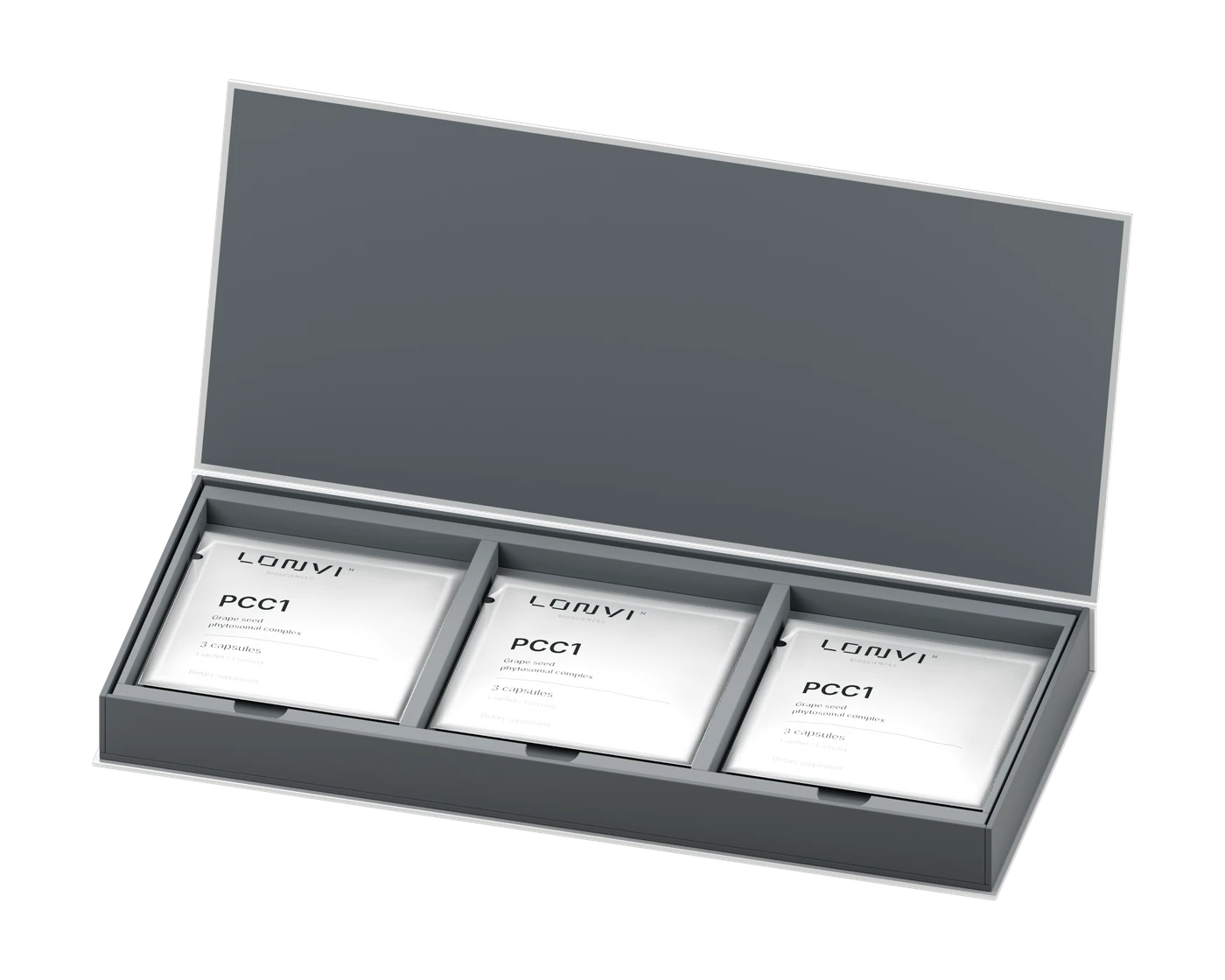
Three active polyphenolsC1 · B2 · Epicatechin
Phytosome deliverySunflower phospholipid complex
One monthly course3 sachets · 9 capsules · 30 days
Nature makes it.
We concentrate it.
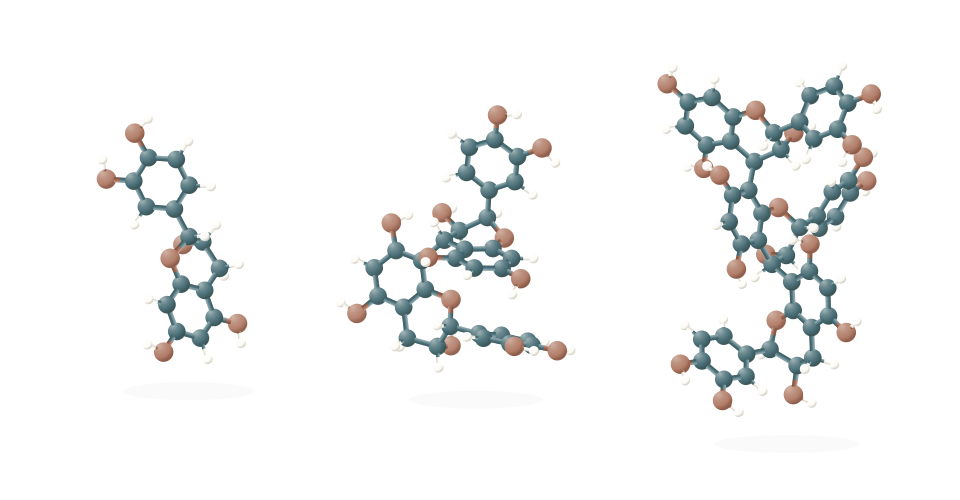
Procyanidin C1 is a trimer: three epicatechin units joined into one polyphenol. Found in grape seeds, it has attracted attention for its ability to influence cellular senescence.
In laboratory and animal studies, C1 has shown both senolytic activity—removing senescent cells—and senomorphic activity—modifying the inflammatory signals they release.
Lonvi PCC1™ combines procyanidin C1, procyanidin B2 and epicatechin in a phospholipid complex. A defined botanical formulation with a precise molecular focus.
PCC1™ names the finished blend. Procyanidin C1 names the individual molecule. Published C1 studies use different preparations and regimens.
Clearing cells.
Changing the
inflammatory signal.
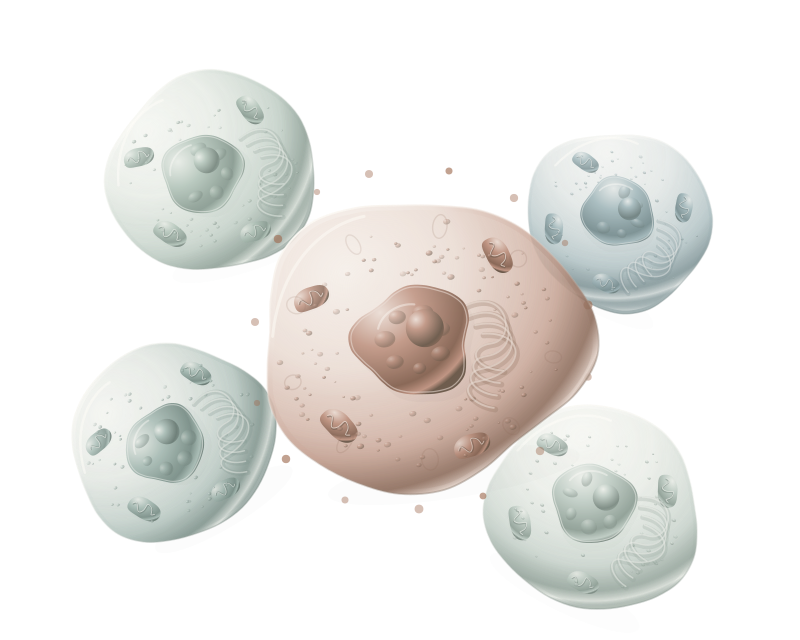
Some damaged cells stop dividing without being cleared. They can accumulate with age and release signals that disturb nearby tissue. Senolytic research asks what happens when that source is removed.
The cell that lingers.
Senescent cells stop dividing but can persist in tissue. Their senescence-associated secretory phenotype (SASP) includes inflammatory cytokines, chemokines and growth factors that alter the surrounding environment.
Conceptual mechanism based on cell and animal research. Liu et al., npj Aging, 2025.
The molecular pathway: apoptosis, PUMA and NOXA
Mechanistic work in senescent cells links C1 exposure to increased reactive oxygen species, altered mitochondrial membrane potential and activation of apoptosis. The BH3-only proteins PUMA (BBC3) and NOXA (PMAIP1) partially mediated the response in the original experiments; knocking them down reduced, but did not eliminate, senolytic activity.
This points to a context-dependent network of survival and death signals. It does not establish a universal targeting mechanism in every tissue. The 2025 immune-ageing study adds evidence of apoptosis in senescent macrophages and changes in inflammatory signalling.
Sources: Xu et al., Nature Metabolism, 2021; Liu et al., 2025. The 2021 paper carries a February 2026 editorial expression of concern relating to a Figure 6b image.
One molecule.
Several lines of evidence.
Research into C1 spans immune ageing, the retina, renal fibrosis and tissue repair. These studies help explain why senescence is a compelling target for longevity science.
Longer survival in aged mice.
A 2026 study of a C1-enriched grape-seed formulation reported median survival after intervention of 37 weeks, compared with 24 weeks in controls.
Wang et al., Biology, 2026. Control n=20; NSPCC1 n=21. Daily NSPCC1 was a different formulation and regimen from Lonvi PCC1™. The result concerns remaining survival after treatment began.
Read the study13 additional weeks of median remaining survival.
Retinal ageing
C1 treatment improved retinal structure and function in aged mice, alongside changes in senescence and inflammatory signalling.
2025 · npj AgingCells & aged miceImmune ageing
Single-cell profiling identified senolytic and senomorphic effects in the ageing blood and immune system.
2025 · FASEB J.Cells & mouse modelsRenal fibrosis
Researchers examined the clearance of senescent renal tubular epithelial cells and reported reduced kidney fibrosis in experimental models.
2025 · FRBMCells & diabetic miceTissue repair
C1 reduced senescent-cell burden and improved wound healing in diabetic mouse models.
These are studies of C1 or specified experimental formulations. They provide biological rationale; they do not demonstrate treatment of these conditions with the finished Lonvi product.
Early human results.
After one course.
Our May 2025 pilot explored changes in blood markers after three days of supplementation. It is an early look at the biology in people, with a clear next step: controlled clinical research.
199-Bio Clinic / Lonvi · Unpublished pilot whitepaper
IL-6
75%
Lower in five participants.
17–48% lower in others.
IL-8
29–52%
Lower across the
reported participant range.
TGF-β1
>85%
Lower in 60%
of participants.
Senescence-associated markers p21 and SA-β-gal also fell. VEGF fell by about 30% in most participants.
Small, uncontrolled pre/post study. The percentages describe reported ranges or subsets, not whole-cohort averages. Biomarker changes are preliminary and do not establish clinical benefit or the percentage of senescent cells removed.
Study design and technical notes
Seventeen participants (nine male, eight female) took three capsules after breakfast for three consecutive days. Fasting blood samples were collected before supplementation and on day 5. The study examined peripheral blood mononuclear cells (PBMCs) and circulating SASP factors.
The historical study used 435 mg complex capsules with a reported 2.8–3.2% C1 content. These are study specifications, not a current per-capsule label declaration. The study had no placebo arm or randomisation and has not been peer reviewed.
We report the whitepaper’s narrative findings. Missing units and an apparent duplicated table row prevent reliable reconstruction of pooled statistics.
Source: Preliminary Report on a Pilot Study of PCC1 Senolytic Complex for Reducing Senescent Cell Burden in Human PBMCs and Blood SASP, May 2025. Request the technical whitepaper.
The molecule is only
half the story.
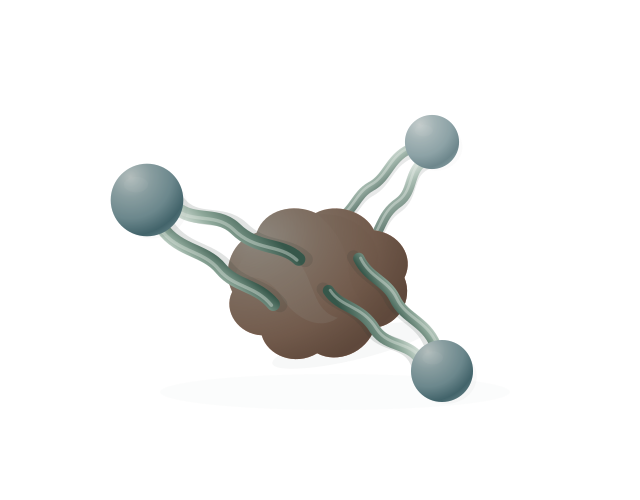
Lonvi pairs selected grape-seed polyphenols with sunflower phospholipids. This phytosome complex is designed to improve delivery of compounds that are otherwise poorly absorbed.
About 5.7×
the bioavailability of standard grape-seed extract, in company measurements.
A formulation measurement reported by Lonvi. This is not a clinical efficacy ratio or a result from the material-testing reports below.
- Active polyphenols
- Procyanidin C1 · procyanidin B2 · epicatechin
- Botanical source
- Grape seed · Vitis vinifera
- Delivery system
- Sunflower-phospholipid complex
- Other ingredients
- Microcrystalline cellulose · magnesium stearate
- Procyanidin C1
- C45H38O18 · epicatechin trimer
- Presentation
- 3 sachets of 3 oral capsules · 9 capsules per box
Three mornings.
Then a pause.
A short course followed by a break. One box provides one 30-day cycle, with each day’s capsules packed together.
Days 1–3
Take one sachet, containing three capsules, once daily with food and water. Breakfast is a convenient time.
Days 4–30
Take no PCC1™. Begin the next course on day 31, repeating the 30-day cycle.
One box · one monthly course
Adults only. Follow pack directions and do not exceed the recommended dose. Consult a healthcare professional if you take medication or have a medical condition. Do not use during pregnancy or breastfeeding. A food supplement does not replace a varied diet and healthy lifestyle.
Purity you
can inspect.
Open analytical reports make the material measurable. View the original Eurofins and SGS documents, with the sample and scope attached to each result.
96.0%
Procyanidin C1 in the tested raw isolate.
Eurofins · HPLC-DAD · Report AAA02443
Raw-isolate lot
SJ20250305 · 8 April 2025
Two materials.
Different measurements.
The raw-isolate result measures the C1 material before formulation. A separate Eurofins report records 2.8% C1 in a submitted phytosome sample.
Neither figure represents finished-capsule purity. The reports describe the submitted samples and their tested lots.
A few useful
distinctions.
For clinicians, researchers and partners evaluating the product and the science behind it.
Is PCC1™ the same as pure procyanidin C1?
No. Lonvi PCC1™ is the finished blend of procyanidin C1, procyanidin B2 and epicatechin, paired with phospholipids. Pure C1 is one molecule within that formulation. The distinction matters when reading research or comparing laboratory reports.
Is Lonvi PCC1™ a medicine or a food supplement?
Lonvi PCC1™ is a food supplement. This page discusses published and preliminary research into its molecular rationale. It is not intended to diagnose, treat, cure or prevent disease.
Why use an intermittent monthly course?
The routine follows the pulse-and-pause approach used in senolytic research: a short exposure followed by an extended break. The product schedule is three days on and 27 days off. It is not a claim that this is the clinically optimal schedule for every person.
What information is available for professional partners?
We can discuss formulation, the pilot whitepaper, analytical reports and supply requirements. Contact 199 Labs for technical or partnership enquiries. The finished product and current purchase options are available at PCC1.shop.
Bring the science
into the conversation.
For clinics, research teams and partners who want to understand PCC1 in more detail.